Some LeetCode problems feel like busy work. The Valid Parentheses problem is not one of them. It’s a clean, well-defined problem that teaches a genuinely useful pattern - the stack - and produces code that’s actually elegant when you get it right.
The problem: given a string containing only (, ), {, }, [, and ], determine if the input is valid. A string is valid if every opening bracket is closed by the correct bracket type, in the correct order.
| Input | Result |
|---|---|
() |
Valid |
()[]{} |
Valid |
({[]}) |
Valid |
([)] |
Invalid: wrong order |
{[] |
Invalid: unclosed bracket |
Reading path: Begin with the concept, use the code or comparison example to make it concrete, and finish with the design trade-off or practical rule.
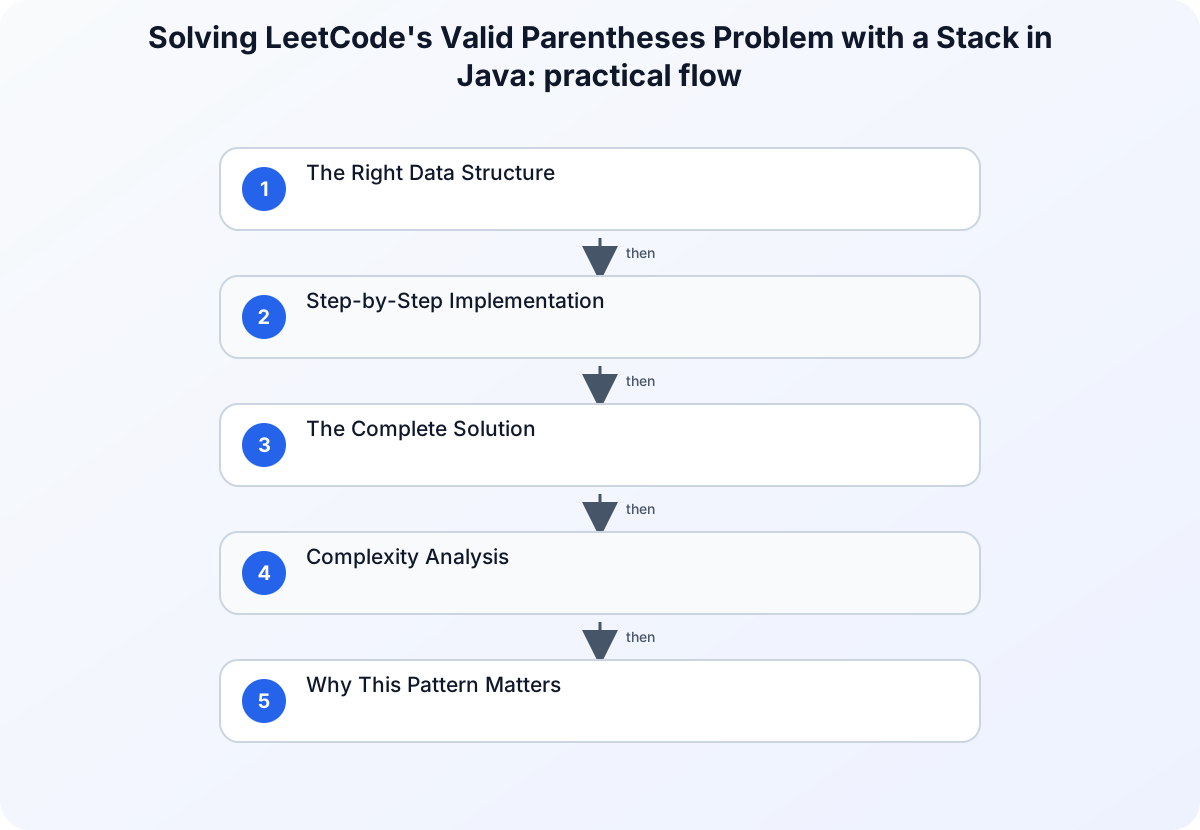
The Right Data Structure
The key insight: you only ever need to remember the most recently opened bracket. When you encounter a closing bracket, you need to check if it matches the last thing you opened.
That’s a last-in, first-out (LIFO) pattern - exactly what a stack provides.
- Start with the sequence
( { [ ] } ). - Push
(, then{, then[onto the stack. - When
]appears, the top of the stack is[, so pop it. - When
}appears, the top is{, so pop it. - When
)appears, the top is(, so pop it. - The stack is empty at the end, so the input is valid.
If at any point the closing bracket doesn’t match the top of the stack, the string is invalid. If the string ends with items still in the stack, some brackets were never closed - also invalid.
Step-by-Step Implementation
Define the Method Signature
public static boolean isValid(String s)
Input is a string. Output is a boolean. Simple.
Create the Stack
Stack<Character> stack = new Stack<>();
We’ll push opening brackets onto this stack as we encounter them.
Iterate Through the String
for (char c : s.toCharArray()) {
Process one character at a time.
Handle Opening Brackets
When we see an opener, push it:
if (c == '(' || c == '[' || c == '{') {
    stack.push(c);
}
Handle Closing Brackets
When we see a closer, two things can go wrong:
- The stack is empty - there’s nothing to match against
- The top of the stack doesn’t match the current closer
else {
    if (stack.isEmpty()) return false;

    char top = stack.peek();

    if ((c == ')' && top != '(') ||
        (c == ']' && top != '[') ||
        (c == '}' && top != '{')) {
        return false;
    }

    stack.pop();
}
Note: we use peek() to check without removing, then pop() only after confirming the match.
Final Check
After processing every character, the stack should be empty. Any leftover items mean unclosed brackets:
return stack.isEmpty();
The Complete Solution
public static boolean isValid(String s) {
    Stack<Character> stack = new Stack<>();

    for (char c : s.toCharArray()) {
        if (c == '(' || c == '[' || c == '{') {
            stack.push(c);
        } else {
            if (stack.isEmpty()) return false;

            char top = stack.peek();

            if ((c == ')' && top != '(') ||
                (c == ']' && top != '[') ||
                (c == '}' && top != '{')) {
                return false;
            }

            stack.pop();
        }
    }

    return stack.isEmpty();
}
Complexity Analysis
| Metric | Value |
|---|---|
| Time | O(n) - each character is processed once |
| Space | O(n) - worst case, all openers pushed to stack |
The space complexity is O(n) in the worst case (a string of n opening brackets with no closers). In practice, for valid strings, the stack depth stays bounded.
Why This Pattern Matters
The stack-based bracket matching pattern appears in real software:
| Concept | Explanation |
|---|---|
| Compilers | validating syntax trees and expression nesting |
| Text editors | bracket highlighting and auto-close features |
| XML/HTML parsers | validating tag nesting |
| JSON parsers | validating object and array nesting |
| Security tools | parsing firewall rules, network protocols, file formats |
Understanding the stack pattern is understanding how a significant portion of parsing works. The Valid Parentheses problem is a good entry point precisely because the problem is small enough to fully grasp in one sitting, but the underlying pattern scales to complex real-world applications.